Legislative Acts
Issue Summary
Problem
What We Proposed
How This Affects Me
Autonomous Driving Deployment Initiative
Autonomous driving technology can protect lives, but Taiwan should not let vehicle rules as primitive as a brick phone block people from using the latest transportation technology. Legislator Ju-Chun Ko is asking the government to recognize international approvals and study an FMVSS self-certification track. On June 10, 2026, Legislator Ko’s office met with the Ministry of Transportation and Communications (MOTC) and the Vehicle Safety Certification Center (VSCC) to discuss autonomous-driving regulation, confirming that FSD Level 2 can be introduced through the existing review mechanism without statutory amendment. On June 16, Tesla Taiwan formally submitted its FSD application documents to VSCC, moving advanced driver assistance deployment in Taiwan one step forward.
Tesla Taiwan has formally submitted FSD application documents to VSCC; technical review, MOTC approval, road testing, and technical committee deliberation still follow.
Brick-Phone Regulation Is Holding Taiwan Back
Imagine the government passing a rule that bans modern smartphones and requires everyone in Taiwan to use a 1980s brick phone. Everyone would see how absurd that is. Yet the same type of outdated thinking is happening in vehicle regulation.
UNECE R79 was adopted in 1988, but it only became fully mandatory for all new vehicle types in Taiwan in 2025. A nearly 40-year-old rule is still shaping whether people in Taiwan can access the latest transportation technology.
R79 is not the only constraint. UN R171 Part I, adopted in September 2024, governs Level 2 driver assistance. UN R157, announced in 2021, governs Level 3 Automated Lane Keeping Systems. If Taiwan continues to rely on years of translation, review, and delayed mandatory implementation, people in Taiwan will keep receiving the same technology 7 to 10 years later than other countries.
Taiwan Can See AI, But Cannot Use It
The Premier has said that Taiwan’s AI initiatives should let people “see AI technology and use AI technology.” Legislator Ko agrees. Autonomous driving is one of the clearest cases where Taiwan can see the technology but cannot fully use it.
Tesla’s next-generation AI5, AI6, and AI6.5 autonomous driving chips are closely tied to Taiwan’s advanced semiconductor supply chain. Taiwan can help manufacture the world’s most advanced autonomous driving chips, yet people in Taiwan cannot use the most advanced autonomous driving capabilities at the same pace as other countries. If Taiwan’s industries can lead in AI, its regulations should not hold them back.
In the same general inquiry, Legislator Ko also emphasized that data governance and AI access are part of whether people can truly “use AI.” The Executive Yuan’s draft Act for Promoting Data Innovation and Utilization has been stalled for more than 194 days, and the pre-announced draft used permissive language throughout instead of assigning clear government duties. He also warned that the gap between free and paid AI tools could widen education, income, and urban-rural divides. Ko therefore asked the Executive Yuan to study an “AI voucher,” “digital voucher,” or similar program modeled on Taiwan’s culture voucher so AI access does not serve only a small minority.
Two Concrete Solutions
1. Recognize Dutch RDW Approvals
In April 2026, the Dutch vehicle authority RDW approved Tesla FSD Supervised for highway use, making the Netherlands the first European country to open the feature. RDW stated that proper use of driver-assistance systems can improve road safety and that the system is safer than comparable systems.
Taiwan is not a UNECE member, but its vehicle regulations heavily reference the UNECE framework. If Taiwan learns from Europe, it should not only copy the rigid parts. It should also learn from Europe’s mutual recognition mechanisms.
Taiwan’s Vehicle Safety Certification Center (VSCC) has had a close partnership with RDW since 2011. In 2012, VSCC signed an agreement allowing it to perform EU Conformity of Production checks in Taiwan on RDW’s behalf, helping Taiwanese vehicle companies obtain EU approvals. With more than a decade of cooperation, Taiwan has a practical foundation to recognize RDW approval results.
At the June 10 meeting, MOTC and VSCC explained that RDW’s provisional type approval for FSD is a national-level approval result. Taiwan can recognize its technical feasibility without waiting for the EU Technical Committee Motor Vehicles (TCMV) to complete later voting, while still conducting Taiwan-specific road-environment suitability testing and review.
2. Add an FMVSS Self-Certification Track
The U.S. Federal Motor Vehicle Safety Standards (FMVSS) use a self-certification system. Manufacturers certify compliance, retain test data, and bring vehicles to market. Government then enforces through post-market testing, recalls, and penalties.
Korea adopted FMVSS recognition when the Korea-U.S. FTA took effect in 2012 and officially allowed FSD to enter Korea on November 12, 2025. Taiwan can follow the Korea model by establishing a dual-track system that accepts both European rules and FMVSS self-certification, rather than forcing companies and consumers through long translation and pre-market review cycles.
This is not deregulation. It is a shift from paperwork-heavy pre-approval toward more effective post-market audits, recalls, and accountability.
Latest Regulatory Status
June 16: Tesla Taiwan Formally Submitted Its FSD Application
Tesla Taiwan has formally submitted its FSD application documents to VSCC, moving the process beyond the earlier status of no formal filing. Next, VSCC must conduct technical review of the application documents and road-test plan, MOTC must complete approval before road testing can begin, and after testing, the technical committee must deliberate based on the results before the case is submitted to MOTC for certification.
Legislator Ko emphasizes that this is not about seeking a privilege for one brand. It is about requiring the government to establish a consistent, transparent, and predictable review process. Any automaker or advanced driver-assistance technology that meets safety standards and regulatory requirements should have a fair chance to participate in review. At the same time, the government must protect road safety rigorously while ensuring administrative delay does not become a practical barrier to responsible innovation.
June 10 Meeting: FSD Level 2 Can Be Reviewed Without Statutory Amendment
MOTC’s June 8 written reply stated that Tesla FSD remains a Level 2 driver-assistance system according to Tesla’s own declaration and the U.S. National Highway Traffic Safety Administration (NHTSA), not a Level 3 automated driving system, and that the human driver remains responsible. The June 10 meeting further confirmed that FSD V13 and V14 can enter Taiwan’s review process under the existing Supplementary Operating Rules for New Technology Driving System Review Reports without statutory amendment.
MOTC also explained that the supplementary rules reference the EU 2018/858 Article 39 mechanism for reviewing new vehicle technologies. Applicants must submit a domestic road-environment suitability declaration and safety validation test reports. A technical review meeting composed of competent authorities, professional institutions, and experts then reviews the case before MOTC approval.
Tesla Has Formally Filed; Review Can Begin
Tesla Taiwan consulted VSCC about the application process on April 28, 2026. MOTC instructed VSCC to send Tesla Taiwan a May 15 letter asking the company to submit a formal application as soon as possible. As of the June 10 meeting, the status at that time was that an application process was underway, but no formal filing had been made. On June 16, Tesla Taiwan formally submitted its FSD application documents to VSCC, allowing the later review process to begin.
Under the procedure confirmed at the June 10 meeting, after formal filing, VSCC will convene a technical committee within 2 to 4 weeks to review the application documents and road-test plan; MOTC approval is expected within 2 weeks; road testing then begins; the technical committee reviews the test results; and the final result is submitted to MOTC for certification. Legislator Ko asked MOTC to complete inter-agency coordination in advance so administrative timing does not become a practical barrier.
FMVSS Dual Track Still Requires U.S. Agreement and Documentation
On a European/U.S. dual-track system using FMVSS self-certification, MOTC replied that under the Taiwan-U.S. reciprocal trade agreement, Taiwan has committed to accepting U.S.-made vehicles built to U.S. Federal Motor Vehicle Safety Standards and emissions standards within 6 months after the agreement takes effect, without requiring additional procedures for market entry. Whether the FSD system used in the United States complies with relevant FMVSS requirements is being confirmed by VSCC through U.S. management mechanisms.
The June 10 meeting also asked MOTC to proceed through three routes in parallel: formally confirm with U.S. counterparts, search public data from the U.S. Department of Transportation, and ask the manufacturer to provide documents showing compliance with relevant FMVSS requirements, so Taiwan does not delay deployment by waiting on a single channel.
UN R79 Steering Equipment
MOTC says Taiwan began harmonizing UNECE R79 in 2006 and established the vehicle safety inspection standard for steering systems. Current implementation is as follows:
| Taiwan standard | Implementation timing | Corresponding regulation series |
|---|---|---|
| No. 47, Steering Equipment | From 2008.01.01 | R79 01 series |
| No. 47-1, Steering Equipment | From 2015.01.01 for all vehicle types | R79 02 series |
| No. 47-2, Steering Equipment | From 2023.01.01 for new types; from 2025.01.01 for all vehicle types | R79 03 series |
| No. 47-3, Steering Equipment | From 2028.01.01 for new types; from 2030.01.01 for all vehicle types | R79 04 series |
UN R157 Automated Lane Keeping Systems (ALKS)
MOTC instructed VSCC to complete draft discussions for the latest R157 00 series revision (R157 00-S6) on March 17, 2026. Stakeholder communication is expected before the end of May 2026, followed by legal procedures.
Drafting for R157 01 and later revisions has also begun and will be discussed with vehicle industry associations and companies. MOTC has also commissioned professional support for autonomous vehicle regulatory adaptation and launched stakeholder meetings on April 22, 2026.
UN R171 Driver Control Assistance Systems (DCAS)
MOTC instructed VSCC to convene vehicle industry associations and companies on March 17, 2026 to discuss technical content for the draft. Because the content is extensive, discussion has not been completed. VSCC expects to convene another meeting before mid-May 2026 to discuss revised drafts and new-vehicle implementation timing before moving through legal procedures.
Road Safety Cannot Wait
Road traffic crashes remain a major global public health challenge. The World Health Organization has reported that roughly 1.35 million people die in road traffic crashes each year, and more than 90% of crashes are linked to human error. Fatigue, distraction, drunk driving, and speeding are exactly the types of risks autonomous driving and advanced driver-assistance systems can help reduce.
Tesla’s 2024 safety report also showed that vehicles using FSD (Full Self-Driving) had a collision rate five times lower than human drivers on urban roads, and were seven times safer across combined road types including highways. AI does not get tired, distracted, or emotional, and can help evaluate risk in milliseconds.
Taiwan recorded 2,950 traffic deaths in 2024, meaning more than eight people died in traffic crashes every day. Autonomous driving and advanced driver-assistance systems are not technology for show. They are tools to reduce human error and protect lives.
Every day the government delays responsible deployment of verified and accountable driving technology, the public remains exposed to risks that could be reduced. Taiwan cannot call itself an AI cabinet while leaving transportation regulation in the past.
Regulatory Safeguards
Autonomous driving spans multiple agencies: MOTC oversees road use and vehicle rules, the Ministry of Economic Affairs handles industrial policy, the National Science and Technology Council supports R&D, and financial regulators are relevant to insurance and liability. Past fragmentation has slowed progress, so the Executive Yuan should establish an inter-ministerial platform to inventory rules and clarify responsibility.
Allowing mature systems such as FSD does not mean an uncontrolled opening. It should be a conditioned, evidence-based deployment. Safeguards can include requiring safety drivers for test vehicles, defining specific routes and time windows, establishing real-time data reporting and incident investigation mechanisms, and regularly reviewing safety metrics before scaling deployment.
Liability rules should also be clearly separated: when a system operates in ADAS mode, the human driver must remain ready to take over and retains responsibility; when a system operates in ADS mode and fully controls the vehicle, responsibility should shift to the manufacturer or operator. Clear liability protects users and forces manufacturers to internalize safety obligations.
Industrial and Social Benefits
Taiwan has a world-class semiconductor and automotive electronics supply chain. TSMC chips and companies such as Foxconn and Pegatron are important partners in the global smart-vehicle industry. But without real-road testing and deployment environments, local companies cannot accumulate the data, software experience, and system-integration capabilities needed to move up the value chain.
Responsible deployment would let AI learn Taiwan-specific traffic patterns, including dense scooter flows, complex intersections, and local driving norms. It can also help logistics, bus, taxi, and other transport sectors facing professional driver shortages. This is a key step for Taiwan to move from “made in Taiwan” to “created in Taiwan.”
Follow-Up Items
Legislator Ju-Chun Ko will continue asking the Executive Yuan and MOTC to complete the following items:
- Inventory the harmonization, announcement, and mandatory implementation schedules for UN R79, R157, R171, and related transportation technology rules.
- Implement the June 10 meeting conclusion by using Dutch RDW approval results in technical-feasibility assessment and publicly explaining Taiwan’s road-environment suitability testing requirements.
- For Tesla Taiwan’s now-filed FSD application, proceed on the confirmed timeline of a VSCC technical committee within 2 to 4 weeks and MOTC approval within 2 weeks, so administrative process does not become a substantive barrier.
- Establish an inter-ministerial regulatory adaptation platform covering vehicle safety, road use, insurance liability, data governance, and crash investigation.
- Accelerate confirmation of FMVSS documentation and U.S. management mechanisms so the European/U.S. dual track can actually be implemented.
Autonomous driving is not science fiction. It is already happening worldwide. Taiwan should not let regulatory inertia make its people second-class citizens in transportation technology. Support Legislator Ju-Chun Ko’s initiative to make Taiwan’s roads safer and its industries more competitive.
Resource Hub
Timeline
[Formal Filing] Tesla Taiwan submitted FSD application documents to VSCC
Tesla Taiwan formally submitted its FSD application documents to VSCC, allowing the later review process to begin. Legislator Ju-Chun Ko asked MOTC and VSCC to maintain rigorous safety review while also improving administrative efficiency and moving technical review, road testing, and later deliberation forward on the confirmed timeline.
[Meeting] FSD Level 2 can be reviewed under the existing mechanism without statutory amendment
Legislator Ko’s office met with MOTC’s Department of Public Transport and Supervision and VSCC to discuss autonomous-driving regulation. The meeting confirmed that FSD V13 and V14 are Level 2 driver-assistance systems that can be introduced through Taiwan’s existing new-technology driving-system review mechanism without statutory amendment. MOTC also confirmed it has recognized the Dutch RDW national-level approval path.
[Procedure] Technical committee within 2 to 4 weeks after filing
The meeting confirmed that after a company formally files, VSCC will convene a technical committee within 2 to 4 weeks to review application documents and the road-test plan. MOTC approval is expected within 2 weeks, followed by road testing, technical committee review of test results, and final certification by MOTC.
[MOTC Reply] RDW, Tesla application status, and FMVSS follow-up
MOTC’s written reply stated that Tesla FSD remains a Level 2 driver-assistance system, RDW issued provisional type approval in April 2026, and Tesla Taiwan had consulted VSCC on April 28 but had not formally filed at that time. MOTC will also confirm whether FSD complies with relevant FMVSS requirements and U.S. management mechanisms.
[Agency Coordination] Road-test safeguards discussed in advance
MOTC convened the Freeway Bureau, Highway Bureau, National Police Agency, and National Highway Police Bureau to discuss safeguards for future road-environment testing in Taiwan, preparing for later review of test plans.
[VSCC] Tesla Taiwan asked to formally file
MOTC instructed VSCC to ask Tesla Taiwan to submit a formal application under the Supplementary Operating Rules for New Technology Driving System Review Reports as soon as possible. As of the June 10 meeting, the matter was in application preparation but had not been formally filed at that time.
[Executive Yuan Response] One-month review promised
Premier Cho Jung-tai responded that the Executive Yuan takes the proposal seriously and will ask the Ministry of Transportation and Communications to organize all concrete information currently held by the government, coordinate with Legislator Ko’s office, and provide study results within one month on RDW recognition and an FMVSS dual-track system.
[General Inquiry] Demand to accelerate autonomous driving regulation
Legislator Ju-Chun Ko compared Taiwan’s outdated vehicle regulations to forcing everyone to use a 1980s brick phone instead of a modern smartphone. He pointed out that UNECE R79, adopted internationally in 1988, only became fully mandatory for all vehicle types in Taiwan in 2025. If Taiwan keeps moving at this pace on R171 and R157, people in Taiwan will use advanced transportation technologies 7 to 10 years later than other countries.
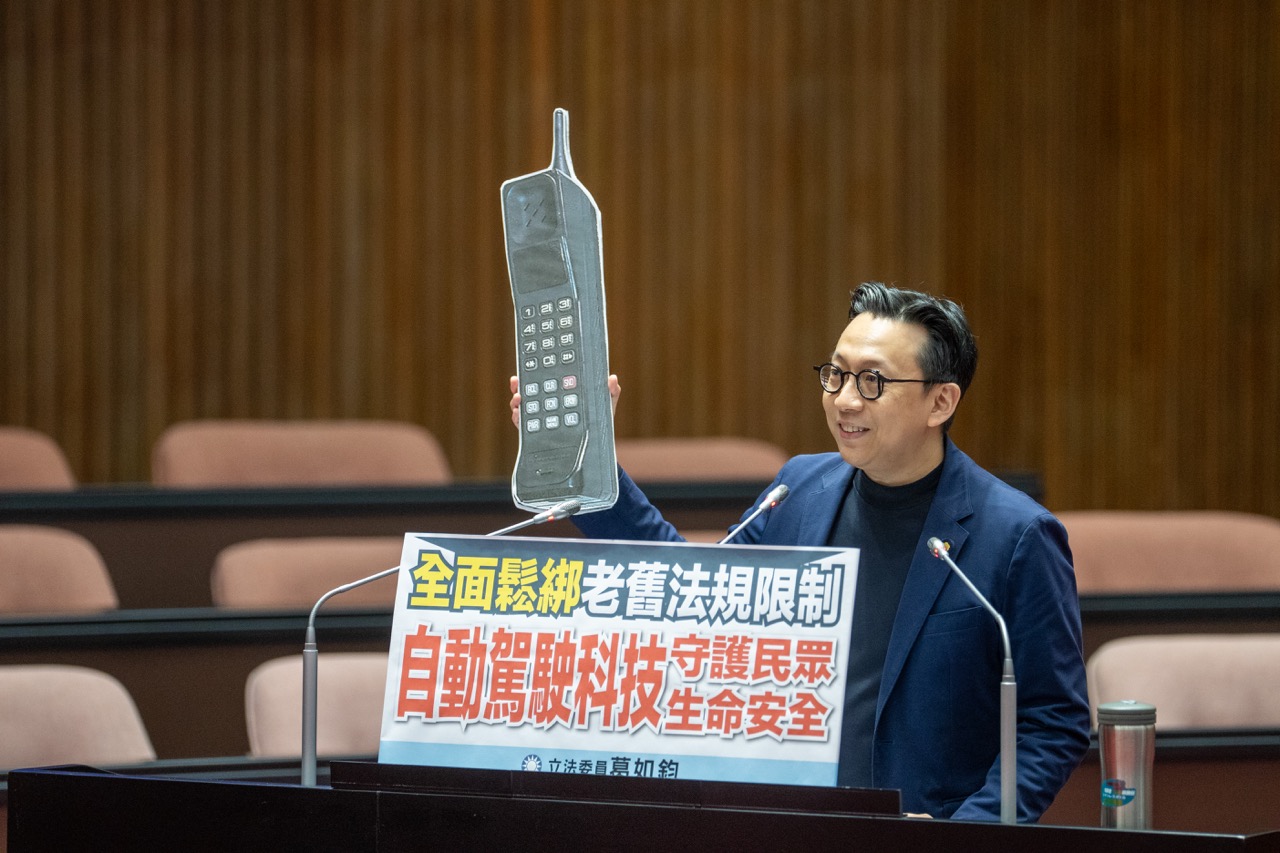
[Press Release] Ko uses a brick phone to criticize outdated rules and calls for AI vouchers and autonomous-driving deregulation
Legislator Ju-Chun Ko’s office issued a press release stating that the AI cabinet cannot remain a slogan. From autonomous driving regulation and data governance to AI access and low-earth-orbit satellite services, the Executive Yuan should provide concrete progress so people in Taiwan can actually use and benefit from technology.
[International Exchange] VSCC exchanged review experience with RDW
To understand RDW’s review practices for FSD, VSCC exchanged experience with RDW, providing reference for Taiwan’s later technical-feasibility and road-environment suitability review.
[MOTC Written Reply] R157 and R171 draft work has started
MOTC stated that VSCC completed draft discussions for the latest UN R157 00 series revision (R157 00-S6) on March 17, 2026, and expects stakeholder communication before the end of May. Drafting for R157 01 and later revisions has also begun. UN R171 technical discussions were convened on March 17, with another meeting expected in mid-May to discuss draft revisions and new-vehicle implementation timing.
[General Inquiry] Call to allow FSD public-road testing
Legislator Ju-Chun Ko stated during a Legislative Yuan policy inquiry that global autonomous driving technology has matured and Taiwan should not remain bound by outdated 2018 rules. He urged the Executive Yuan to create an inter-ministerial platform and study allowing Full Self-Driving (FSD) public-road testing so people in Taiwan do not become “third-class citizens in transportation technology.”
[International Progress] FSD entered Korea
Korea adopted FMVSS recognition when the Korea-U.S. FTA took effect in 2012 and officially allowed FSD to enter Korea on November 12, 2025. This demonstrates a practical path for Taiwan: self-certification and post-market oversight can replace slow article-by-article translation and pre-market review.
[Facility Launch] Changhua ARTC Smart Vehicle Autonomous Driving Test Site
Built with a NT$1 billion investment from the Ministry of Economic Affairs, the site supports all-weather and full-speed testing and can simulate extreme conditions such as dense fog and heavy rain, providing an international-grade verification environment for Taiwan’s autonomous driving industry.
[Taiwan Progress] UN R79 03 series became mandatory for all vehicle types
MOTC says Taiwan began harmonizing UNECE R79 in 2006, but R79 03 only became mandatory for all new vehicles in 2025. The latest R79 04 series is scheduled for new vehicle types in 2028 and existing vehicle types in 2030.
[International Regulation] UN R171 Part I adopted
UN R171 governs Driver Control Assistance Systems (DCAS) for Level 2 driver assistance. Legislator Ko warned that if Taiwan keeps its current pace, full implementation may lag other countries by more than seven years, while R171 Parts II and III still lack a clear review schedule.
[Committee Review] Transportation technology regulatory stagnation
During committee review of the AI Basic Act, Legislator Ko raised serious concerns about the slow progress of amendments to the Unmanned Vehicle Technology Innovation Experimentation Act.
[International Regulation] UN R157 on Automated Lane Keeping Systems announced
UN R157 governs Automated Lane Keeping Systems (ALKS) for Level 3 automated driving. Legislator Ko noted that if Taiwan only reaches full mandatory implementation in 2031, it would again be roughly a decade behind.
[Facility Launch] Tainan Shalun Taiwan CAR Lab
Taiwan’s first closed autonomous vehicle testing site opened, providing basic scenarios such as tunnels and pedestrian crossings.
[Legislation] Unmanned Vehicle Technology Innovation Experimentation Act promulgated
The law established Taiwan’s autonomous vehicle sandbox mechanism, but development has remained largely confined to experimental frameworks rather than public-road deployment and broader use.